Agent or SaaS? Wrong Question
Agent or SaaS? Wrong Question.
Own the system of record, then make it smarter.
This week I tweeted a simple question: “An Agent? or SaaS? That is the question.”
It lit up. The most popular answer by far was “Both.” A few people said SaaS is dead. A few said agents are just a feature. One person asked, “What is the difference?” Fair question.
Here’s my answer. It’s the wrong question.
Agents and SaaS do different jobs. At the end of the day, you need a good data model, and you need a smart way to feed it and interpret it. The companies that win own the system of record for their niche, then make it smarter every quarter. That’s true for Salesforce, and it’s true for a two-person pre-seed startup.
After 20 years and 300+ pre-seed investments, I’ve watched a lot of platform shifts. The one thing that never changes: whoever owns the data that matters gets paid.
They do different jobs
SaaS records the work and enforces the workflow. It’s the ledger. Agents decide and act. They read the ledger, make a call, and go do something.
One reply nailed it. Shubham wrote: “Harness deterministic behaviour is needed to guide agent’s stochastic behaviour.” Translation: your system of record is the part that has to give the same answer every time. The agent is the part that uses judgment. You want both, and you want the judgment sitting on top of the truth.
Another reply, from nidhin, got to the heart of what customers actually buy: “People pay not to use sophisticated UI or tools, they need to get shit done.” Nobody wakes up wanting an agent or a SaaS app. They want the outcome. The architecture underneath is your problem, not theirs.
Salesforce opened the doors
In June, in Surviving Softwaremageddon, I wrote that Salesforce was unlikely to own the agentic layer. That turned out to be true. They didn’t build it. They partnered for it.
On its Q2 FY27 call in August, Salesforce announced Claudeforce with Anthropic: Claude and 37 prebuilt sales skills sitting right on top of the CRM. Meeting prep, deal health, pipeline reviews. Agentforce passed $1.5B in ARR, up 240%. Marc Benioff’s line: “Frontier models depend on CRM. They don’t replace it.”
Here’s why that matters. Almost everything you want to do with your sales data needs more than Salesforce. You need your ERP, your marketing stats, your billing system. No single SaaS vendor is going to own the brain that sits across all of it. What Salesforce did was smarter than trying. They opened the system of record so outside intelligence can read it, write to it, and act on it.
John Eng from Right Side Capital called it in my replies before I did: “Systems of record and action with UI and headless. Priced how the customer wants it.”
The system of record is the hub
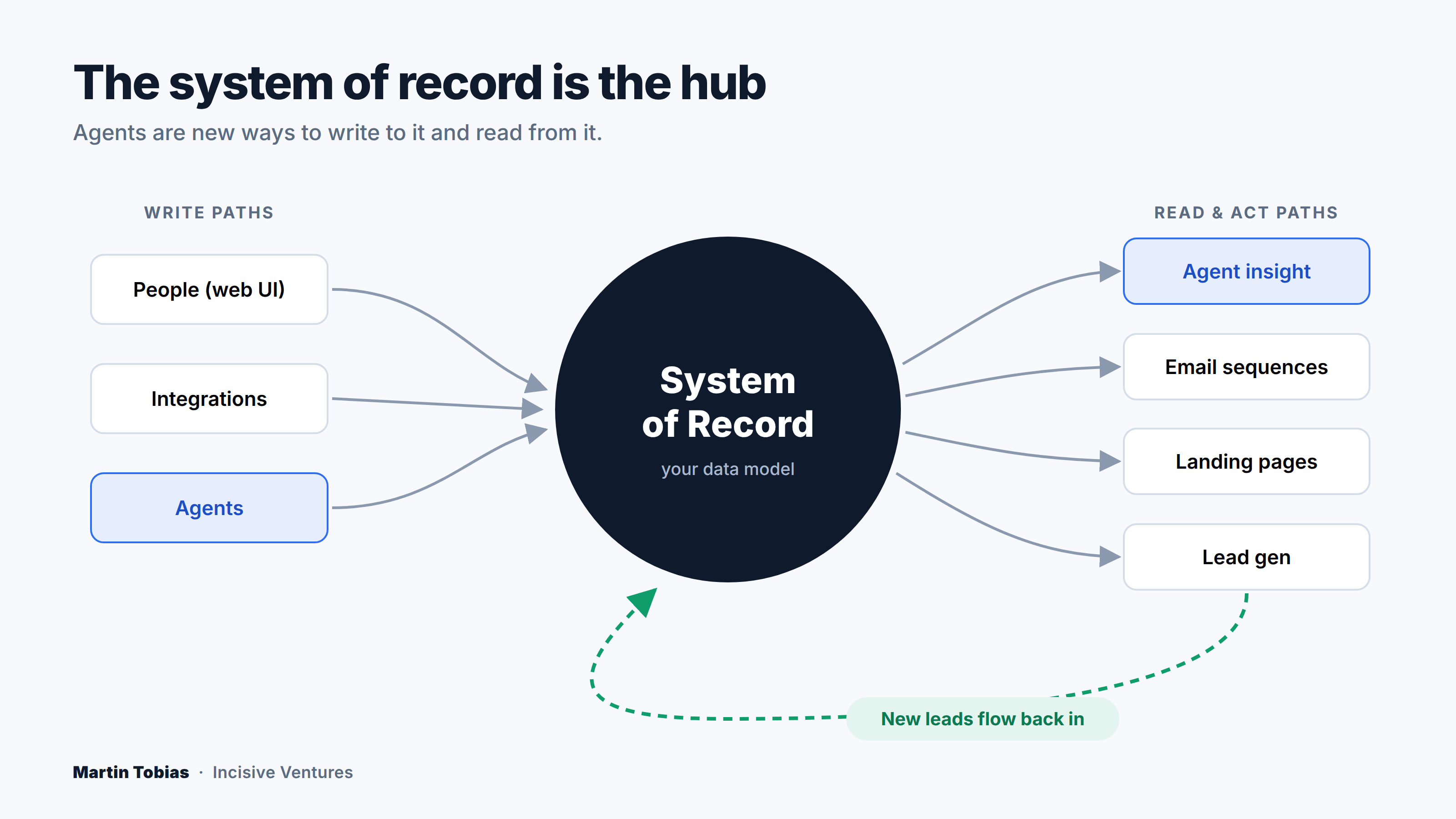
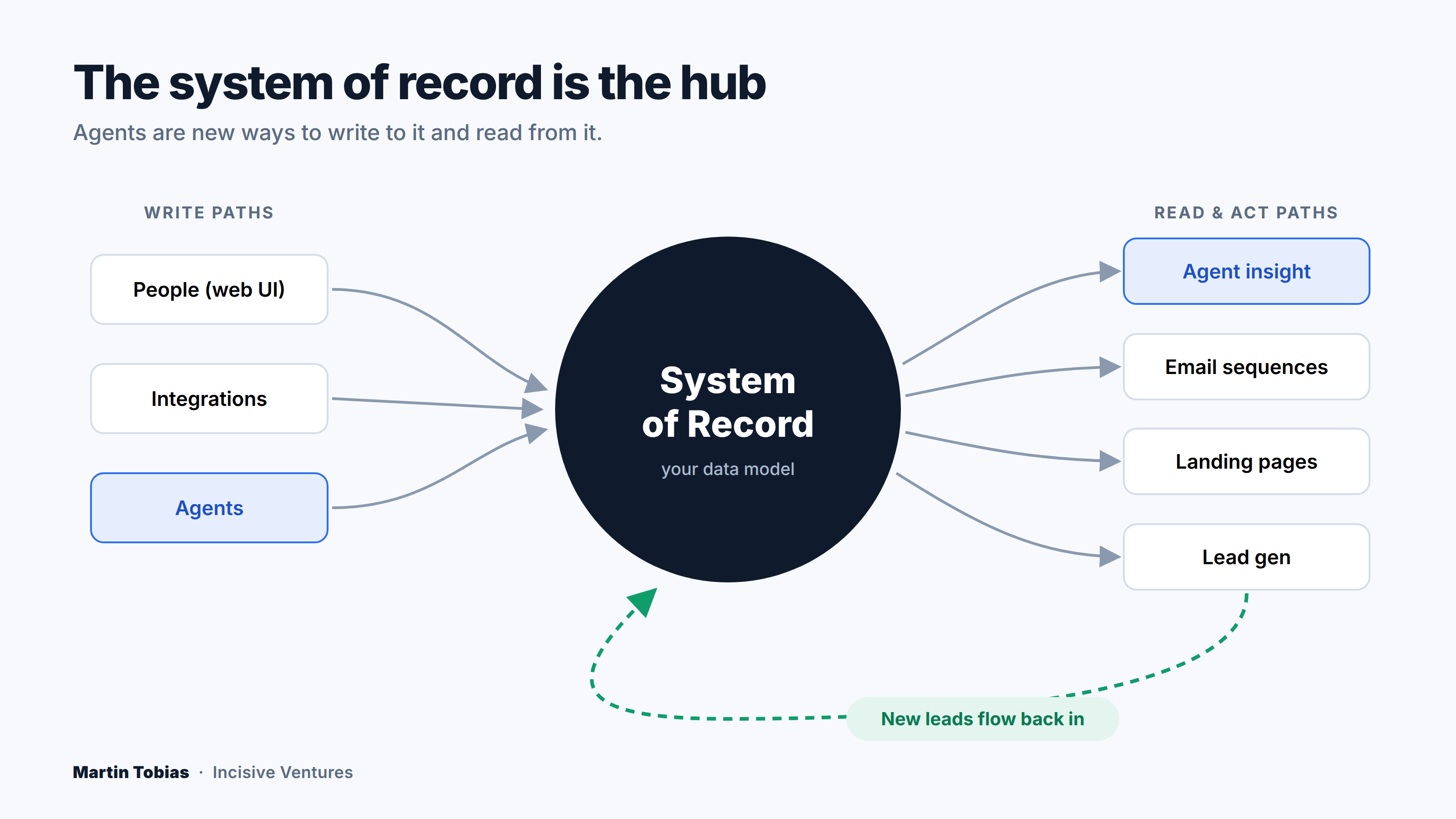
Think of the system of record as the hub. People write to it through the web UI. Integrations write to it. Now agents write to it too. On the other side, agents read it and act: they spot insight, run email sequences, build landing pages, generate leads. And those new leads flow right back into the record. That loop is the business.
That’s the validation. SaaS isn’t getting replaced. The SaaS companies that open their systems of record to agentic analysis will do fine. The ones that don’t are in trouble.
LinkedIn built a wall
Now look at the opposite strategy.
LinkedIn is the system of record for your business network. And LinkedIn is building a wall around it. No agents, no third parties, and they monetize the data themselves. This month they won a permanent ban and a data-destruction order against a scraper called ProAPIs. The message to every builder is clear: stay out.
I think that’s a losing strategy. Your network is worth more when you can put it to work: when your CRM, your outreach agent, and your research tools can all use it. The system of record that stays open to connections and agentic workflows is going to win this era. The ones that build walls, like LinkedIn is doing now, are the ones I predict will be the failed systems of record.
Same starting position as Salesforce. Opposite bet.
The 10x rule
So what does this mean if you’re a pre-seed or seed founder? You don’t have petabytes of customer data. You have a laptop, a co-founder, and a problem you’ve lived for years.
Start here: whatever you build, your new way has to be 10x better than the old way. Not 20% better. Nobody rips out a workflow for 20%.
I see three ways to get to 10x:
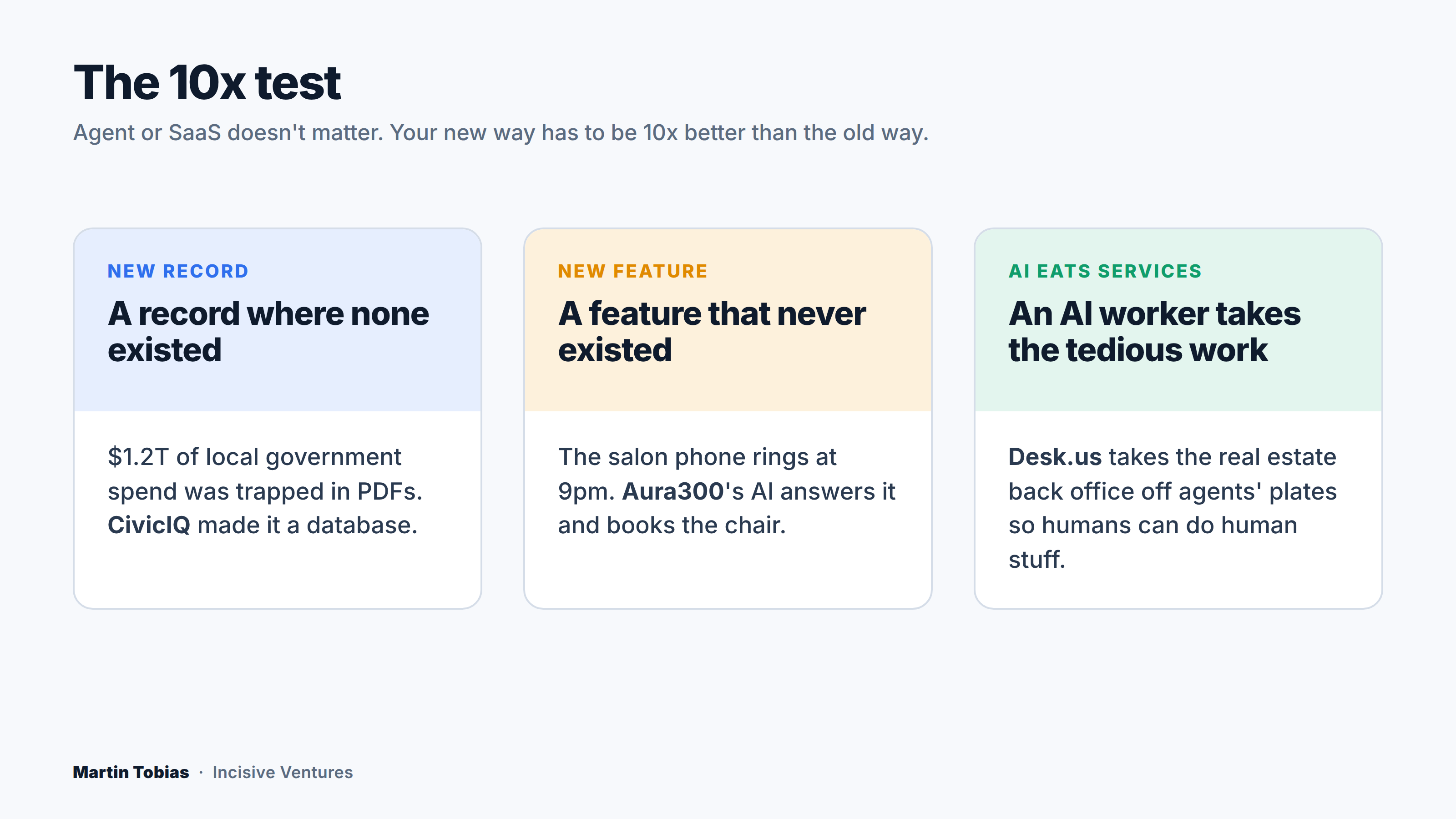
- A system of record where none existed. The data is trapped in PDFs, spreadsheets, and inboxes. You’re the first to structure it.
- A feature that never existed. The salon phone rings at 9pm and an AI answers it and books the chair. That wasn’t possible three years ago.
- An AI worker takes the tedious work. AI eats services. The low-value back-office grind goes to software so humans can do more human stuff.
The 10x test
Agent or SaaS is an implementation detail. The 10x is the business.
Three paths to the same hub
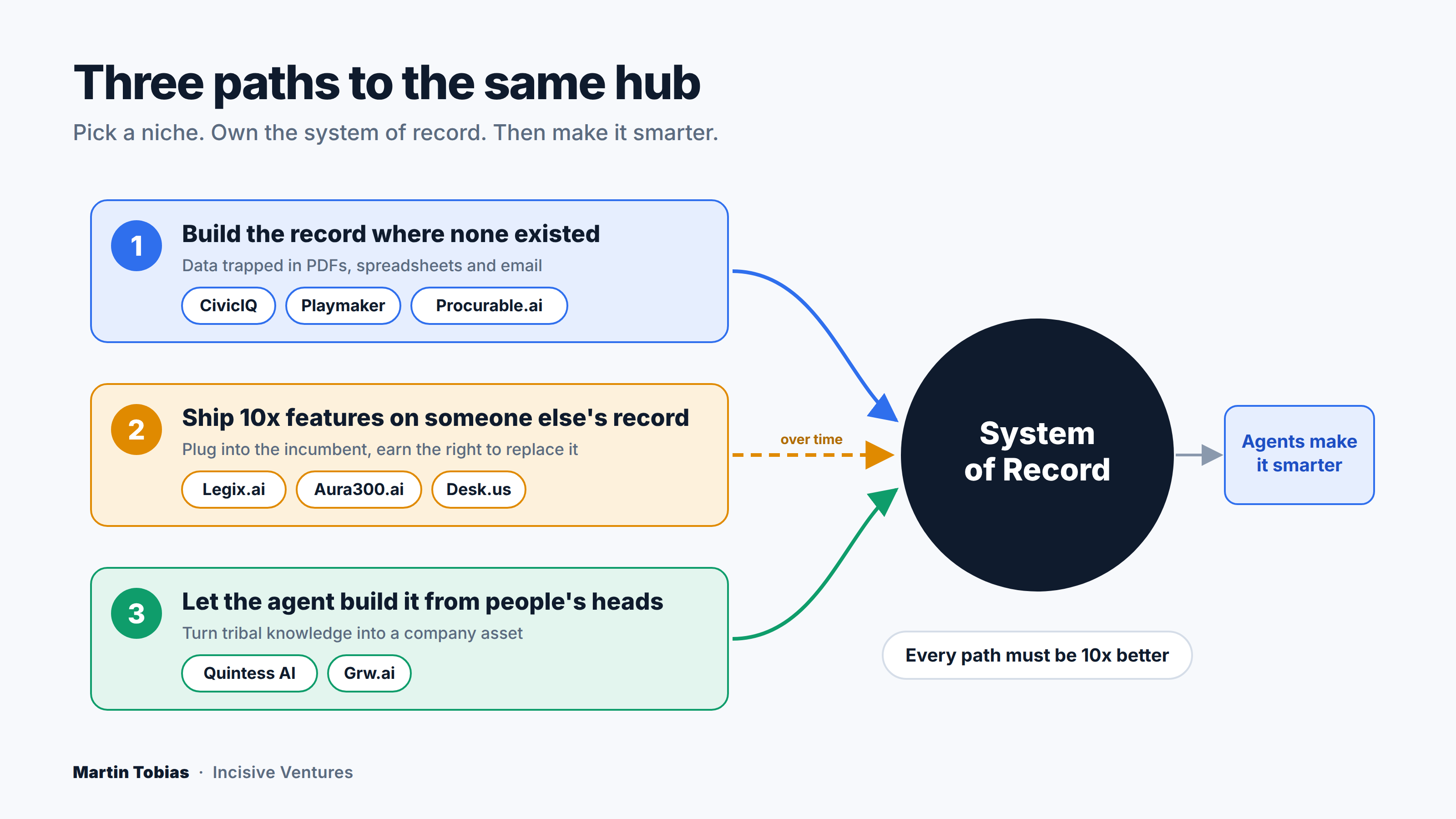
In my portfolio, I see founders getting to the system of record three different ways. Same destination, different go-to-market.
Three paths to the same hub
Path 1: Build the record where none existed
Some markets don’t have a system of record at all. The data lives in PDFs, spreadsheets, and email. That’s the opening.
CivicIQ. Local governments spend $1.2T a year, and the data on that spend is fragmented, unstructured, and sitting in PDFs. The founder watched his parents struggle with local government RFPs. AI made a previously impossible database buildable. Now there’s a system of record, and agents can match vendors to the right RFPs.
Playmaker. The $100B brand-to-team sponsorship market runs on spreadsheets and email. The founder spent 10 years managing Anheuser-Busch’s $400M sports sponsorship budget. She knows exactly what’s broken. Playmaker builds the record, then the intelligence: matching brands to teams, pricing deals, proving ROI.
Procurable.ai. A VP of Supply Chain lived supplier chaos for six years: spreadsheets, ERP exports, surprises. Procurable gives manufacturers a live map of suppliers, parts, and risk, then agents that flag disruptions and suggest alternates. I was the first check in.
Path 2: Ship 10x features on someone else’s record
You don’t have to build the database on day one. You can plug into the incumbent, deliver something 10x better on top of it, and earn the right to replace it later. Expect a wave of M&A in the next few years as incumbents realize what they missed. Either you replace them or they buy you. Both are fine outcomes.
Legix.ai. Starts as a QuickBooks add-on for accounting firms that can’t hire fast enough. When I asked my own bookkeeper about the problem, he said, “How soon can I sign up?” Start on top of QuickBooks, earn the right to do more.
Aura300.ai. Plugs into the booking software salons already use. Then AI agents go to work: one answers every call 24/7 and books appointments, one wins back lapsed clients, one runs the Meta ads. Salons don’t change systems. They just stop losing chairs.
Desk.us. Starts by replacing the human transaction coordinator in residential real estate. The AI reads the contract, tracks every deadline, and builds the signing packets: 500+ Seattle agents, 100+ closings a month, under 0.2% errors. The bigger story is the whole real estate back office. All the tedious work goes to software so agents can do the human part.
Path 3: Let the agent build the record from people’s heads
This is the one I’m most excited about. In a lot of companies, the most valuable data was never written down. It lives in the heads of the people who’ve done the job for 30 years. When they retire, it walks out the door.
Quintess AI. One founder spent 10 years in Paris subway maintenance. Quintess builds voice agents for 60-year-old mechanics who hate paperwork. They talk, the agent listens, and tribal knowledge becomes a searchable company asset. The agent is the write path. The data didn’t exist until the agent captured it.
Grw.ai. The founder ran a 1:1 coaching business for a decade. Great results, impossible to scale. Grw turns that coaching playbook into 24/7 AI coaches for SDRs. The expert’s head becomes the system of record.
You’ll see shades of this in Procurable too. The best supply chain knowledge is in the VP’s head, not the ERP.
The playbook
If you’re building at pre-seed or seed right now, here’s what I’d do.
Pick a niche the labs ignore. Don’t build where OpenAI and Anthropic are pointed. The durable companies live in the unglamorous plumbing of a specific industry: municipal RFPs, sports sponsorships, subway maintenance.
Name your record. Be able to say in one sentence what data you’ll own that nobody else has. If you can’t, you’re a feature.
Prove the 10x. New record, new feature, or AI worker. Pick one and make it undeniable. Your first customers should say what my bookkeeper said: “How soon can I sign up?”
Open the doors, don’t build walls. Be Salesforce, not LinkedIn. Let other agents and systems read and write to your record. Openness is what makes you the hub.
Add a new write or read path every quarter. A new integration, a new agent, a new way to capture data or act on it. Every path makes the record more valuable and harder to rip out.
The last word
In my replies I wrote that we still run a majority of on-prem software 20 years after the invention of the cloud. Old systems don’t vanish. They get wrapped, opened up, and made smarter.
So stop asking agent or SaaS. Ask what record you’ll own, and how smart you can make it.
If you’re building that, I want to hear from you.