SaaS Isn't Dead: It Just Got a Much Bigger Budget
SaaS Isn't Dead: It Just Got a Much Bigger Budget
Softwaremageddon, five months later: where all that intelligence goes, and how I'm investing through the whipsaw.
In February, Wall Street decided AI kills software. In October it changed its mind. In November it decided AI itself was over. Then Nvidia's CEO came back after eleven days out, and AI was back too.
Four stories in ten months.
Through all of it, LPs and other investors kept asking me the same question: "How do you invest in software with this AI thing happening?"
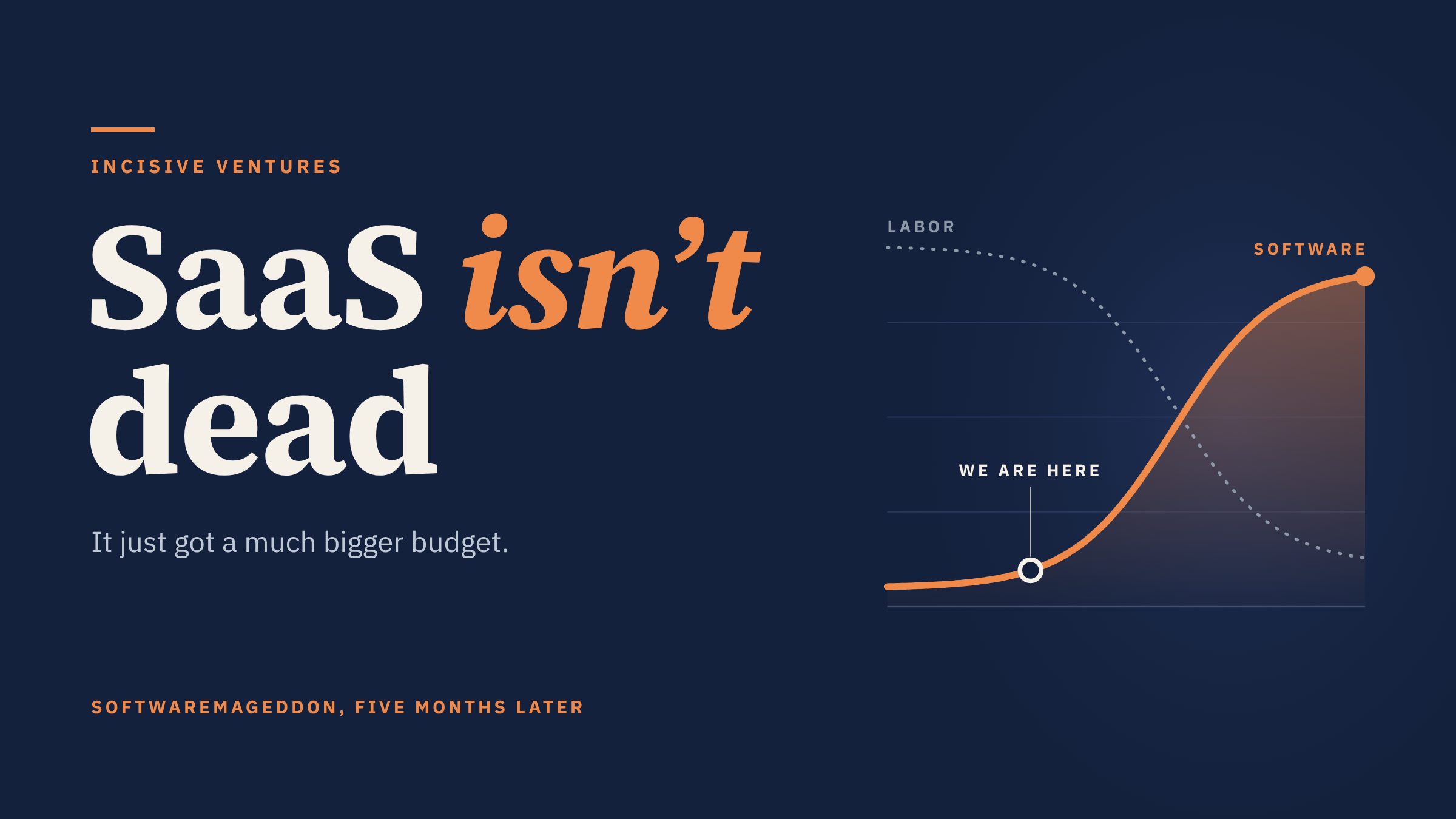
Here's my answer. SaaS isn't dead. It just got a much bigger budget. I think demand for software goes up about 10x, and I think this is the best time in my career to be writing pre-seed checks into it.
In June I wrote Surviving Softwaremageddon and said the panic was overblown. This is the follow-up, with five more months of receipts. I've been investing in early-stage software for more than 20 years, and I've made over 80 pre-seed B2B software investments in the last six. Six are unicorns. This week I walked a room of investors through the argument, with three of my portfolio CEOs on the call. This is the written version.
The market told four stories. Demand told one.
Start with the tape.
- February: "AI kills software." The S&P 500 software index lost 26% from late January to its April low. Wall Street called it the SaaSpocalypse. I wrote about it as Softwaremageddon. Same movie.
- October: "Never mind." By October 6 the same index was back at its highest level since November 2025.
- November 5 to 20: "AI is over." Chip stocks fell almost 30% from their peak, and the S&P 500 dropped seven days in a row.
- November 23: "AI is back." Nvidia jumped more than 30% in a single day when its CEO returned.
My favorite part: in one November week, the market sold chips because AI was finished and sold Salesforce because AI agents were going to replace its seats. Both can't be true.
Nobody knows how this resolves into valuations. Anyone telling you they do is selling you something.
Now look at what customers did during those same ten months.
- Tokens flowing through OpenRouter went from about 10 trillion a week in February to 209 trillion a week in early November. That's roughly 20x.
- Google went from 480 trillion tokens a month to more than 3.2 quadrillion. 7x in a year.
- Agents (software, not people) used 76% of OpenRouter's tokens in October. A year earlier it was 8%.
- Nvidia reported a $115.8 billion quarter, up 103%.
The swings were in prices. Demand for intelligence went one direction the whole time.
And notice who's buying. Software can consume intelligence a lot faster than you can type into a chat box. Software is now the customer.
Where does all that intelligence go? IMO: Into software.
Here's the whole argument in one sentence. AI is infrastructure, and infrastructure needs new software to make it work for a specific job in a specific industry.
A salon can't use a raw model. Neither can a sales team or a city procurement office. Somebody has to build the thing that knows the job.
That's why I think software gets about 10x bigger. Some of that is existing SaaS adding intelligence to what it already sells. Most of it is net new software that could never have been built before.
Possible ran ahead of actual. That gap is the opportunity.
In June I wrote about Possible vs. Probable vs. Actual. There's a better name for the space between possible and actual. Sequoia calls it the diffusion gap.
I've borrowed their frame. The world economy is about $120 trillion, split roughly in half between physical work and cognitive work. It took around 200 years for machines to take over the physical half. Sequoia projects the same curve for the cognitive half, in something like 50.
So all cognitive work can be done by machines. That doesn't mean it will be by Tuesday.
Everyone watches the frontier and the next model release. The frontier matters if you're curing cancer or inventing new materials. Most of the world isn't on the frontier. Most businesses are technology laggards (I say that with love) who want their work done better, faster and cheaper, and it takes them real effort to adopt anything new. AWS launched in 2006. Twenty years later, companies are still moving to the cloud.
February's mistake was pricing what's possible as if it had already happened.
The brain needed arms and legs.
One job has crossed the gap. Programming.
There are about 1.5 billion knowledge workers in the world. Roughly 30 million of them are software developers. That's 2%.
Models could write code for years, and developers used AI assistants for three of them. The job didn't change. Then Anthropic shipped Claude Code, which plugged the model into the codebase, the terminal, the tests and GitHub. The model is the brain. The software around it is the arms and legs. I call that a harness.
Look at what happened next.
- In mid-2025, 23% of developers used AI agents every week. By mid-2026 it was 90%. (Two different surveys, Stack Overflow's and JetBrains', same direction.)
- At Google, the share of new code written by AI went from 25% to 75% in eighteen months.
- Meanwhile only 15% of legal, tax and accounting organizations use an agent at all.
Lawyers and accountants have access to the same brain. They don't have the harness.
The clock starts when the harness arrives. One job can flip in a year or two. Building the harnesses for everybody else, the other 98% of knowledge workers and then blue-collar work, is ten to twenty years of work. Models can't do it alone. Neither can chips or data centers. Somebody has to write the software.
That's what I fund.
More software. Less labor. A smaller bill.
How big does it get? Here's the math I gave the room.
Businesses spend about $650 billion a year on application software. They spend $10 to $20 trillion a year on the labor and services that software can now do.
Old software helped a person do the job a little faster, and it got paid out of the IT budget. New software does the job, so it gets paid out of the labor budget.
If software takes a quarter of a $20 trillion labor bill, that's $5 trillion of new software on top of today's $650 billion. Call it 10x. (David George at a16z gets to about $5 trillion for AI applications by a different route.)
And the customer pays less in total. Budget moves from payroll to software, the work still gets done, and the bottom line gets better. That's why they buy.
More of that software gets built for one industry, too. Early software was horizontal: spreadsheets, generic databases, build it yourself. Cloud made vertical apps possible. The AI layer makes them faster to build and a lot smarter. Euclid Ventures estimates that vertical apps alone become about a $3 trillion market by around 2040.
Three harnesses you couldn't build three years ago
Theory is cheap. Here are three founders I backed at pre-seed, who joined me on the call.
CivicIQ(Abbas Khan). Local government is a $1.2 trillion spending market that never had a system of record. CivicIQ reads the meeting minutes, agendas and budgets of more than 76,000 U.S. agencies, so a vendor can see what a small town in Nebraska wants to fix. Before, that town stayed stuck with the same vendor for ten years because nobody else knew it had the problem. Abbas made the point better than I can: no general-purpose model is going to read 100,000 government websites a day for you, at least not at a price you'd pay. Build for one buyer and you can.
Aura300(Adriano Di Giulio). Adriano grew up around his family's salons, hearing the same complaints every night: missed calls, empty chairs. Aura300 is an AI front desk that answers every call, around the clock, and books, rebooks and cancels inside the booking software the salon already uses. It works with 17 of them. A general model can hold a conversation. It doesn't hold the key to the booking system. And nobody opened a salon to answer the damn phone. They opened it to do hair.
Grw.ai(Alex McNaughten). Alex spent 14 years building revenue teams. His diagnosis: most companies adopted AI bottom-up. The CEO buys everyone a ChatGPT or Claude seat and hopes. You get scattered experiments and no ROI anyone can measure. Grw goes top-down and builds each revenue team its own system for the work behind every deal: call prep, follow-ups, CRM updates, pipeline reviews. They test about 1,000 real sales tasks against every new model and route each task to the best one. Alex's take is that AI is killing one-size-fits-all software. I agree.
None of the three could have been built on the old SaaS stack. None of them is fighting for an existing software budget, either.
How I'm investing through it
In June I gave you four rules: avoid the blast radius, find the niches, bet on the gap between demand and supply, and back fast iterators early. They held. Here's what I'd add after five more months.
Back the harness. Skip the brain. The labs will keep shipping better brains, and every one of them makes my companies better. I want the software that finishes the job.
One job, one industry. Hair salons. Local government sales. B2B revenue teams. The narrower the job, the deeper the harness and the harder it is to copy.
Find the founder who lived the job. Adriano in the salon. Alex with 14 years of sales teams. That kind of insight beats an incumbent's head start.
Start where the incumbent has nothing. I saw 20 or 30 pitches for "an AI CRM that beats Salesforce." I passed on all of them. People are still running 30-year-old SAP, and legacy software is brutally hard to rip out. Deel did it right (I was a pre-seed investor). It started in international hiring, where the incumbent had no product, spent its first three years as that incumbent's partner, and then went out and competed.
Price against the labor budget. An app company's pricing power comes from what the customer would otherwise pay a person, and token costs keep falling. That's why app companies can get profitable on a small fraction of the revenue a lab needs.
Ignore the tape. Watch the tokens. Sentiment will keep swinging, on Wall Street and on Main Street. Neither changes what a salon owner gets from a front desk that never misses a call.
Buy before the job flips. Once a harness lands, the job can change in a year. I want to own the company before that, which means pre-seed.
It is Still Year one
In June I said we're three years into a thirty-year movie.
Five months later the market has changed its mind four times and the plot hasn't moved. One job has its harness. The other 98% are waiting for theirs. This is year one of the part where that software gets written.
AI doesn't get anywhere without software. That's the bet.
If you're building the harness for one job in one industry, reach out.
— Martin Tobias