All In on Harnesses
I Passed on Wrappers. I'm All In on Harnesses.
(Why B2B harnesses will be the best investment category of the next 10-20 years)
The labs are coming for your app. That's the fear I hear in every other pitch meeting right now. OpenAI ships a feature, and a hundred startups die overnight. Anthropic launches a product for an industry, and a whole category gets repriced.
Some of that fear is earned. Most of it targets the wrong thing.
I passed on LLM wrappers, and I'm going all in on harnesses. I think B2B harnesses will be the best investment category of the next 10-20 years. Here's why, and how I'm investing in them.
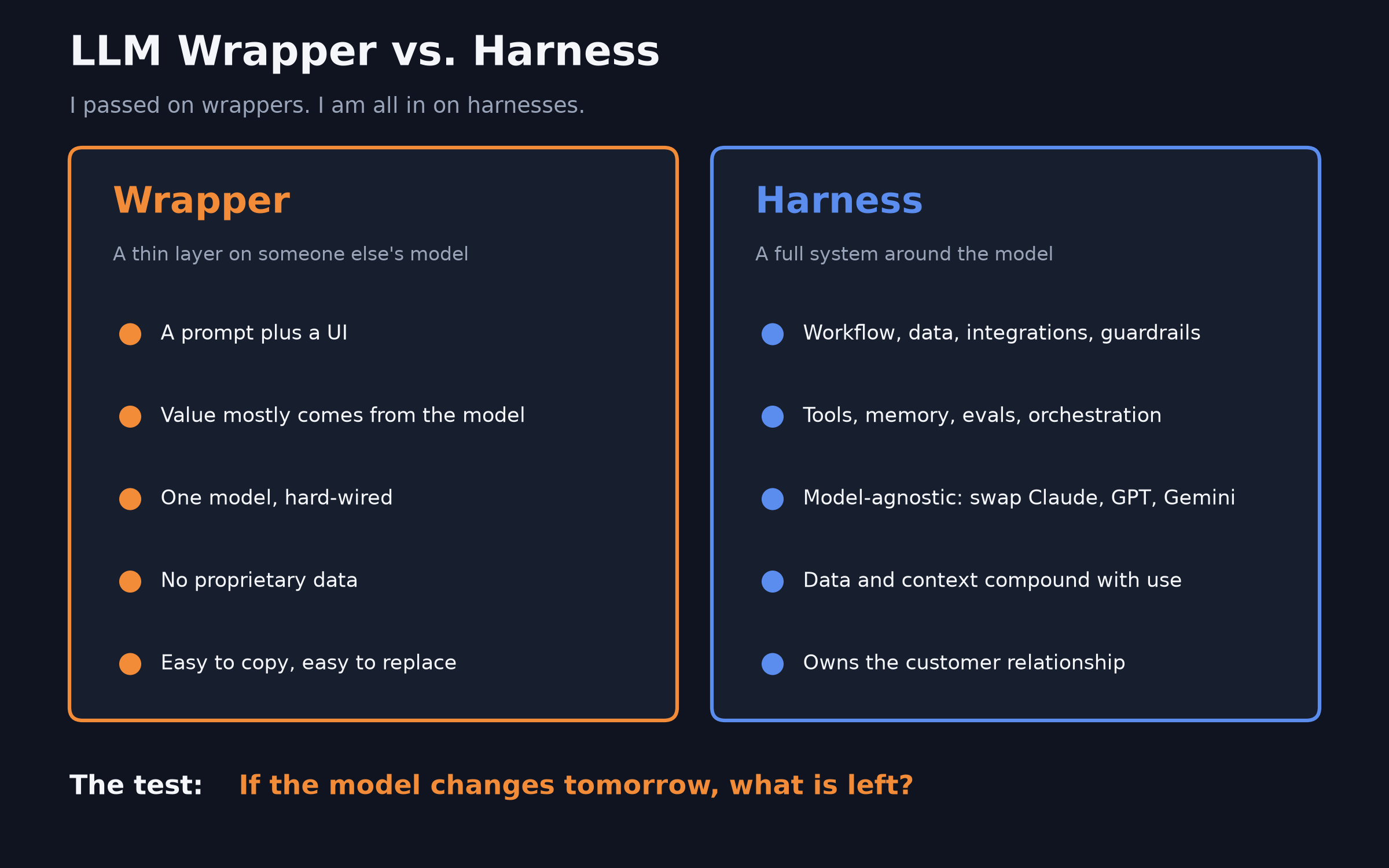
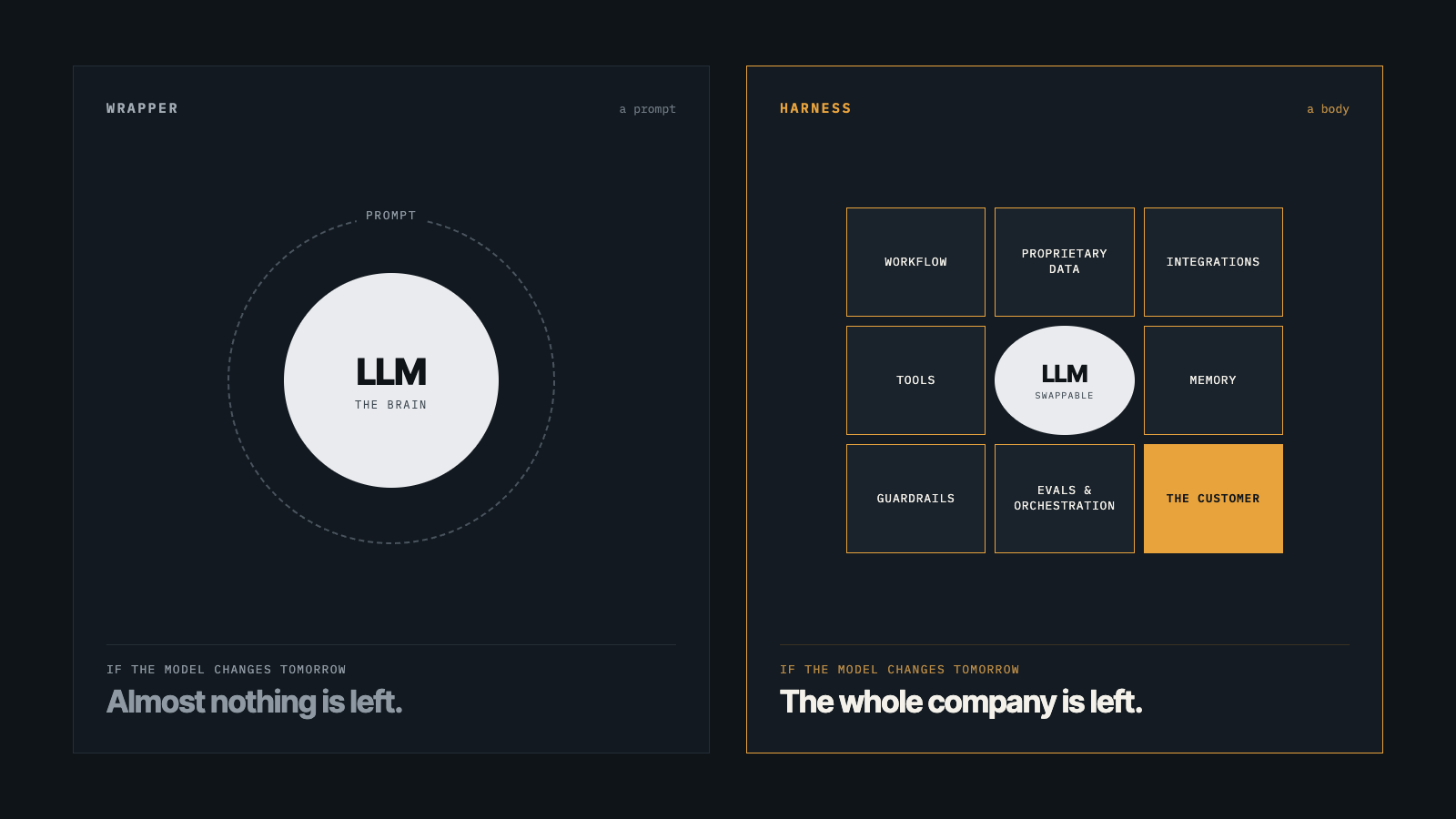
A wrapper is a prompt. A harness is a body.
Wrappers are basically complex prompts to the LLM: instructions telling the brain how to act and how to think. They are thin, and their value is small in the final output relative to what the LLM contributes.
A harness gives the brain a full body and the resources to do real work. Here's my definition, in two halves:
- The job: the workflow, proprietary data, integrations, and guardrails around a model.
- The scaffolding: the tools, memory, evals, and orchestration that let an agent finish multi-step work.
Two properties make it investable. A harness is model-agnostic: swap Claude for GPT or Gemini and the company still works. A harness also owns the customer relationship. The customer signs with the harness, not with the model underneath it.
This isn't my private vocabulary. Both leading labs use the word. Anthropic's engineering team describes the harness around Claude as the progress logs, feature lists, git checkpoints, and end-to-end testing that let an agent work across many sessions. OpenAI calls the Codex agent loop its "harness". In its harness engineering write-up, OpenAI says early progress was slow "not because Codex was incapable, but because the environment was underspecified."
Same brain, different results. The system around the model decides the output.
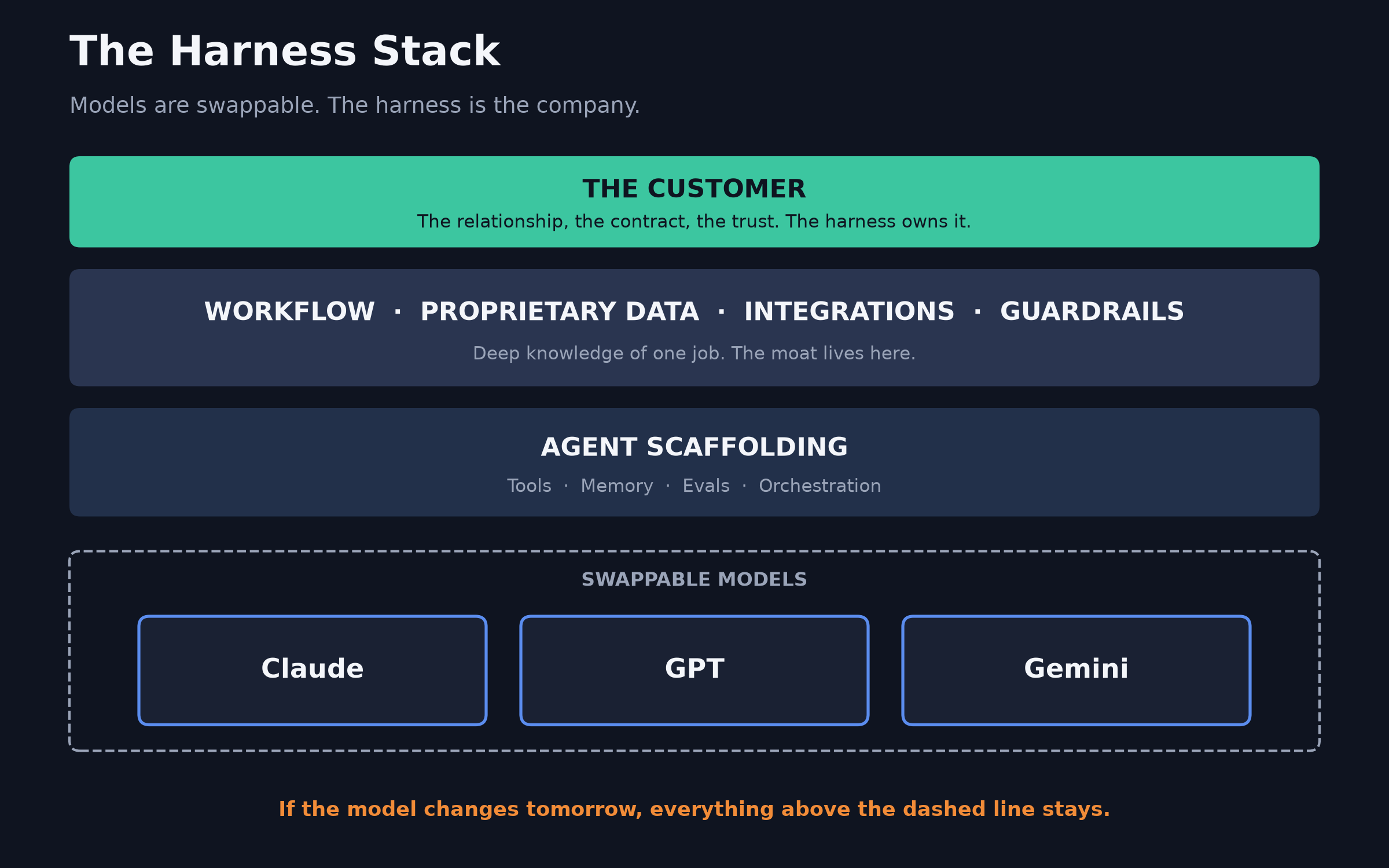
The test is simple: if the model changes tomorrow, what is left? For a wrapper, almost nothing. For a harness, the whole company.
Wrappers didn't get killed. They got revealed.
Remember OpenAI's DevDay in November 2023? ChatGPT added native file upload, and the line going around was that a lot of startups had just died. The best post-mortem I've read put it right: those companies "were not killed by DevDay; they were revealed by it." They had no proprietary data, no workflow lock-in, and no switching costs. Any competitor could copy them, including the model provider.
That's the wrapper problem in one sentence. If the model does 95% of the work, the model company eventually takes 100% of the value.
The labs will own some jobs. Coding is the first.
I'll be honest about where the labs win. Look at Anthropic's data on which occupations are most exposed to AI today:
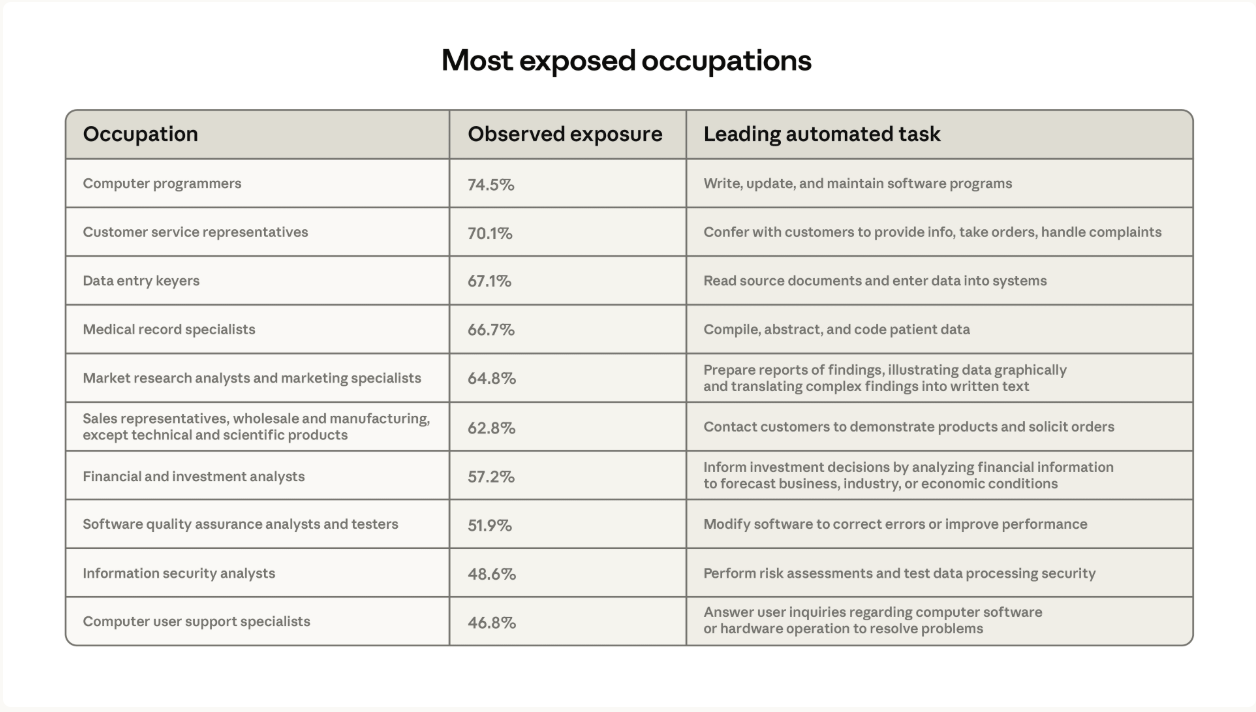
Computer programmers top the list at 74.5% observed exposure. Then come customer service reps (70.1%), data entry keyers (67.1%), medical record specialists (66.7%) and market research analysts (64.8%). Financial analysts (57.2%), QA testers (51.9%) and support specialists (46.8%) are further down.
These are big, horizontal jobs that look the same in every company. That's exactly where a lab points its own products.
The labs don't have a choice. Anthropic's S-1 shows estimates of total compute obligations running from $400B to $750B+. When you owe that much, you need the biggest markets on earth. A voice agent for hair salons won't pay a $750B compute bill.
And look at how early this is. Most of Anthropic's recent growth comes from one knowledge-worker segment: programmers. There are 1.5 billion knowledge workers worldwide, and only 2% of them are programmers. Think about that. The most valuable AI company in the world has monetized part of 2% of its potential market. This is a 10-20 year process.
Coding built great businesses. Not durable ones.
Coding was the first job AI really cracked, and the early traction was unreal. Cursor went from $500M to $1B in annualized revenue between May and October 2025. Lovable passed $100M ARR eight months after its first $1M, then doubled to $200M four months later. Replit grew from $2.8M to $150M in annualized revenue in less than a year.
I passed on all of it.
Anthropic launched Claude Code in February 2025. By late 2025 it had passed Cursor's run rate. Cursor's revenue kept climbing, but its position didn't. Per Ramp corporate-card data, its share of AI coding spend fell from roughly 41% to about 26% between June 2025 and May 2026, while Anthropic's moved toward 50%. Sacra estimates Cursor was running at about -20% gross margins. It was paying retail for the brain its biggest competitor got at cost.
Then it sold. SpaceX, which owns xAI, bought Cursor for $60B, and the deal closed August 14, 2026. What did the buyer want? Not the margins. Sacra's read is that xAI got "the massive dataset of developer edits & completions it needs to build a competitive coding model." Cursor shipped Grok 4.6 the week the deal closed. The harness and its data were the asset. They became training fuel for a lab.
Great outcome for Cursor's investors. But it makes my point. Good businesses have been built, and will be built, around jobs like coding. They aren't durable. When your job sits at the top of the labs' list, the labs either beat you or buy you to feed their models.
Durability lives in verticals and niches far from the 10 jobs Anthropic and the LLMs want to be good at.
Yes, the labs are going vertical. They're taking the generic layer.
- OpenAI and Anthropic both launched healthcare products in January 2026: ChatGPT Health, OpenAI for Healthcare, and Claude for Healthcare.
- In finance, Claude for Financial Services ships data connectors and 10 ready-made agent templates. OpenAI followed with a version built with Morgan Stanley and Evercore.
An Anthropic executive said it out loud: "you're starting to see us do our own product work and go vertical."
So read what they actually shipped. Connectors. Templates. Chat over clinical and financial data. That's the generic layer of a vertical, the part that looks the same at every hospital and every bank. If your product is "chat over clinical search," you should be worried.
Deep workflow and data harnesses are safe. The labs aren't building an integration into one health system's EHR rollout, or the rules for one MLS, or the booking software at a salon in Dublin. Even inside their own finance launch, Rogo and Hebbia, two finance harnesses, run on all three labs' models.
The S-1 says it too. It lists Salesforce, Snowflake, Accenture, and Deloitte as ecosystem partners. Anthropic wants to be the engine under vertical apps, not the vertical app itself.
And here's the number that should make every vertical founder smile. Even Anthropic's $100K+ customers spend less than 0.1% of their total expenses with Anthropic. The rest goes to workflows, data, and services. That's where vertical software lives.
The proof is already public.
Harvey (legal). CNBC reported Harvey went from $100M ARR in August 2025 to about $190M in January 2026. It has since reported crossing $400M. Harvey is "multi-model by design": it routes legal work across models from multiple labs. That's model-agnostic: it owns the customer, sits on top of the labs, and grows anyway.
Abridge (clinical documentation). It passed $100M in ARR by mid-2025 and is live at 300+ health systems, including a Kaiser Permanente rollout to 24,600 physicians. It isn't a better prompt. It's integration into the clinical workflow at some of the biggest health systems in America.
What I'm actually backing.
Here are some harnesses in my portfolio, each in a job the labs aren't pointed at.
Grw.ai (sales execution). Grw's agent, Taylor, preps every meeting, drafts follow-ups, updates the CRM after every call, and chases deals that go quiet. It builds your best rep's playbook once and runs it across every rep. It shows up inside Slack, Teams, and Claude via MCP. The model is a component. The playbook and the pipeline data are the company.
Aura300.ai (salons and aesthetic clinics). Remember the hair salon voice agent that won't pay a lab's compute bill? Aura300 is building it. It runs three coordinated agents: Emma on reception, Yuki on retention, and Nami on social booking. They work inside the salon's existing booking software, such as Phorest, Fresha, Timely and Vagaro. They are live at 80+ salons and clinics across five markets, while there are over 200,000 of their ICPs in the US, plenty of room to grow in the vertical. While a big niche, no lab is writing integrations for Vagaro.
Desk.us (real estate transactions). Desk is an AI transaction coordinator that watches agents' email, reads their contracts, tracks deadlines, and drafts the paperwork. Its site says "5% of NWMLS runs on Desk." That's knowledge of one region's forms and timing rules that no general model ships with. Realestate workflows are very regional and fragmented, leaving it outside the target zone for the general models.
CivicIQ (government sales). CivicIQ monitors council meetings, capital improvement plans, and contract expirations across 100,000+ state, local, and education agencies, scanning 1.5M+ public documents a month. It turns them into ranked buying signals 6-18 months before the RFP drops. And here's the tell: it ships an MCP server so Claude can plug into its data. The lab becomes a distribution channel for the harness, not a competitor. The fact that CivicIQ is structuring a previously unstructured data set creates durable value.
Every one of these passes the test. Swap the model tomorrow, and the integrations, data, workflow, and customer are still there.
How I'm investing through it.
- Stay out of the blast radius. If your product sits in one of those top-exposure jobs and looks the same in every company, the labs are pointed at you.
- Own the data exhaust. Every call logged, contract read, and agenda scanned makes the harness smarter. The model doesn't keep that. You do.
- Integrate where it's ugly. Booking systems, MLS forms, council PDFs, CRMs. The unglamorous plumbing is the moat.
- Stay model-agnostic. Route to whichever brain is best and cheapest this quarter. Model competition becomes a tailwind on your cost of goods.
- Own the customer. Your logo should be on the contract.
Three years into a thirty-year movie.
A lab can only chase so many jobs directly. There are thousands of workflows further from the LLM, in salons, brokerages, city halls and sales floors, and every one of them needs a harness.
The human brain is very good at harnessing. The computer brain is already better at some harnessing tasks, like writing code, and it keeps getting better. The next 10-20 years will be spent working out which brain does which job.
The labs build the brains. The harnesses own everything else. I know which side of that trade I want.
If you're building a harness for B2B software that reduces friction at scale, reach out.
— Martin Tobias